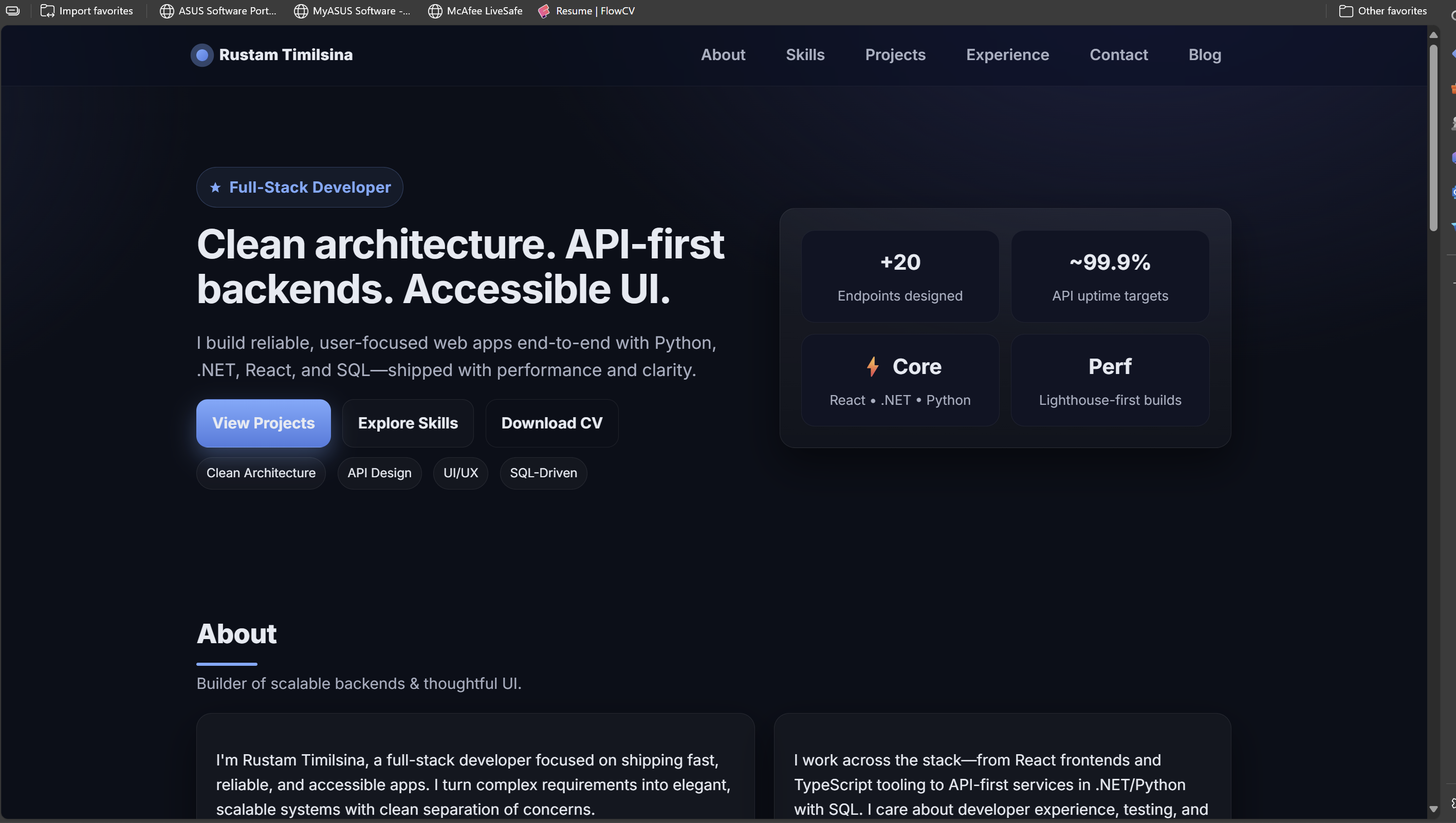
Building my first personal portfolio was both exciting and terrifying. I knew it had to represent me — not just as a developer who can write code, but as someone who is continuously learning, experimenting with architectures, and putting themselves out there on the web.
💡 Starting from Scratch
I deliberately avoided heavy boilerplates and prebuilt themes. I opened a blank editor and started writing plain semantic HTML5 and modern CSS. At first, things were rough — alignments felt off, fonts looked unpolished, and I questioned every visual decision. But by focusing on structural consistency and clean layout rules, the site quickly began taking shape.
“The best way to learn web development is by actually building and deploying something — no matter how small.”
⚙️ Tools & Architecture
Rather than adding gigabytes of node dependencies, I focused on core engineering discipline:
- HTML5 & Semantic Landmarks: Clean header, main, section, and article tags for accessibility.
- Modern CSS3: Custom variables, fluid clamp typography, and glassmorphism styling.
- Vanilla JavaScript: High-performance event handlers without framework runtime overhead.
- Vercel & Git: Continuous automated deployment linked directly to GitHub commits.
<header class="navbar">
  <a href="index.html" class="brand">Rustam Timalsina</a>
  <nav class="nav-links">
    <a href="index.html">Home</a>
    <a href="blog.html">Blog</a>
  </nav>
</header>
🚀 Deployment Journey
When I first hit “Deploy” on Vercel, I half-expected something to break. But within 45 seconds, the build passed, SSL certificates were generated, and I had a live, globally CDN-distributed URL. Seeing rustamtimalsina.com.np resolve online for the first time was pure momentum. It immediately transformed coding from an isolated local experiment into something real that anyone in the world could interact with.
✨ What’s Next
This portfolio is an evolving foundation. Next, I plan to continue detailing real-world backend architectures, documenting lessons from local AI and retrieval pipelines, and demonstrating practical software design principles.